Product Strategy: The Foundation for Product Success
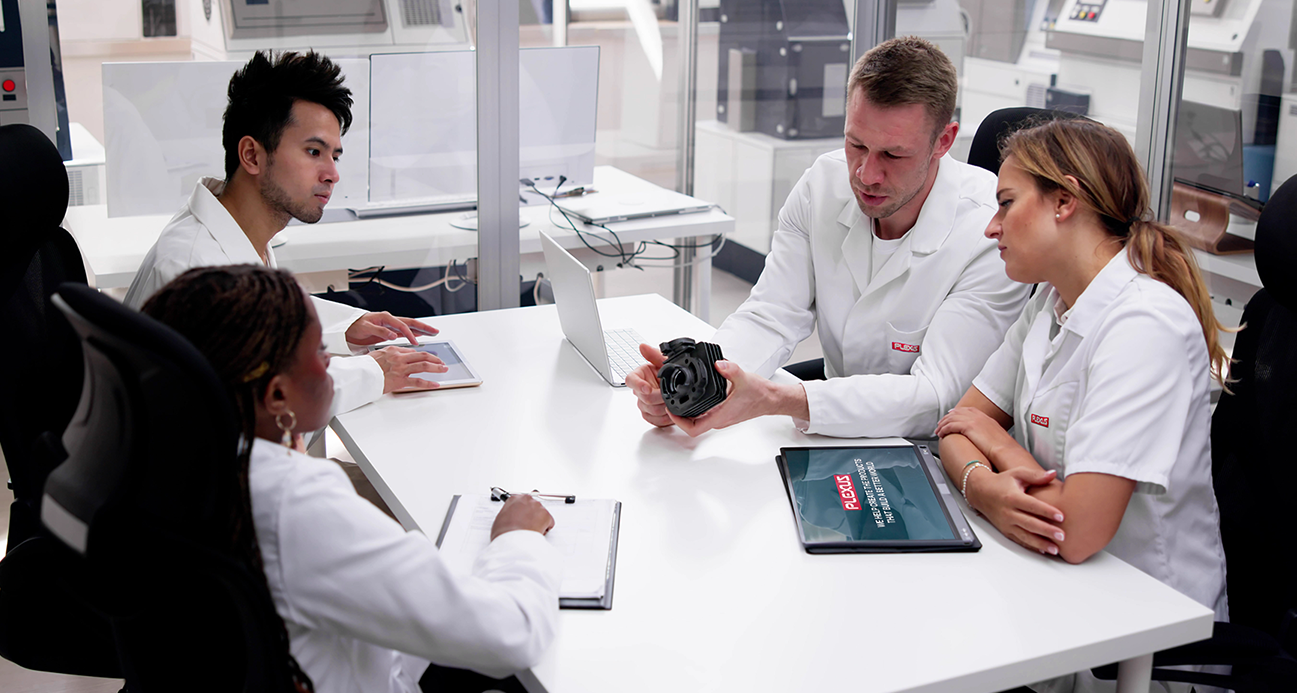
For innovators in technology, a brilliant idea is just the starting line. The real race begins when you try to turn that idea into a tangible, marketable product. Many companies, from nimble startups to established industry giants, share a common pain point: investing millions of dollars and countless hours into a product development effort, only to launch a product that fails to meet market demand.
This isn’t just about bad luck; it’s a systemic issue often rooted in a flawed approach to the earliest stages of the product life cycle. The rush to get to market can lead to a critical misstep: starting the product design and engineering process without a solid product strategy in place. This can result in costly redesigns, prolonged development cycles and in the worst cases, a product that is technically sound but commercially irrelevant.
At Plexus, we believe a critical investment that an Original Equipment Manufacturer (OEM) must make is in the strategic groundwork that happens long before product design begins. Our integrated engineering services guide you through this critical phase, helping you confidently answer two critical questions before development begins: “Are we making the right product?” and “Are we making the product right?”
The Plexus Value: An Integrated Foundation
Before the concept of a product can become a reality, a clarifying framework must be established. This process, called Product Strategy, is a foundational capability within our comprehensive design and development offerings. This phase is less about building and more about strategic thinking. It’s a solution-neutral process where we challenge assumptions, validate market needs and translate a high-level vision into a powerful framework to guide engineering decisions in subsequent product design.

A Common Design Pitfall: Insufficient Problem Definition
Product teams regularly come to Plexus with a fairly complete product design. Once we dig in, we often find gaps in the considerations factored into that design. This can include not accounting for volume manufacturing processes, regulatory requirements, future servicing needs – and the list goes on.
In Product Strategy, we spend time defining the true problem to be solved from the perspective of all stakeholders throughout the entire product life cycle, as well as the needs and constraints of the business. The end result is a framework for viable product pathways, and an understanding of the cost of those pathways. This enables our customers to better understand the total product cost and ultimately determine their customer’s willingness to pay.
Reducing Risk through Early Engagements
The core advantage of partnering with Plexus is our ability to reduce our customer’s risk in designing and launching innovative products. Our integrated approach starts with early engagements that combine multiple areas of expertise, including:
- Technical Expertise: A deep understanding of user experience, user interface design, software development and machine learning, ensuring the product is technically viable and aligned with technology trends.
- User Analysis: Expertise in qualifying user value and driving meaningful decisions based on user research.
- Manufacturing Considerations: Planning for a stable supply chain, scalability and cost efficiency for years into the future.
- Regulatory Considerations: Understanding the regulatory path and the impact to requirements as feature and workflow decisions are made.
Our User-Centered Design (UCD) and Systems Engineering teams are experts in navigating numerous development priorities. These disciplines lead the strategic engagement, ensuring a meaningful user experience and a sound technical architecture, while facilitating deep collaboration with our specialized engineering services as needed, from regulatory specialists to manufacturing experts.
The Multi-Stage Product Strategy Approach
Our methodical approach is structured to maximize efficiency while gathering deep and relevant insights across collaborative stages. While built on defined and proven steps, this approach is always tailored to our customer’s needs and current phase of development. One illustration of the phases is represented in the example below:
Stage 1: Immersion
Our Product Strategy approach begins with a crucial Immersion stage. The primary objective is to gain firsthand experience with the current user experience and workflows. Plexus experts often conduct on-site visits or deep-dive simulations to immerse themselves in the operational context. We move beyond simple requirement gathering to understand the entire ecosystem in which the product will live.
This deep immersion allows us to gain genuine insight into the technical aspects, context, usability and the true cost of existing pain points. The outcomes of this phase include a clear understanding of core user needs, user profiles and existing workflows; confirmed alignment on business goals and priorities; and the first level of prioritization for possible features and benefits, along with an initial perspective on the regulatory approach (as applicable).
Stage 2: Tech Exploration and Stakeholder Interviews
Multi-disciplinary teams identify critical knowledge gaps and focus their exploration on key technologies that could enable the desired solution. This involves researching emerging technology and assessing the feasibility of various technical approaches.
Simultaneously, we conduct detailed interviews with key users, technical subject matter experts and business stakeholders. This phase is critical to identifying possible existing technologies—either within your organization or available commercially—that can be leveraged to accelerate development. The outcome is a mapping and prioritization of stakeholder needs that begins to illustrate the possible solution spaces to explore.
Stage 3: Archetype Development

This is where the strategic thinking coalesces into concrete directions. Our UCD and Systems Engineering leaders begin exploring a range of Archetypes—mental models of interaction, system concepts, initial architectures in the form of block diagrams—to simulate use and assess workflow variants. This early-stage modeling allows us to test assumptions rapidly without investing in costly hardware prototypes.
We then lead a cross-functional co-creation workshop with your team to establish preliminary product parameters. The workshop’s collaborative nature creates alignment across business, design and technical stakeholders.
The critical outcomes bring the analysis of all stakeholder needs together. First is the validation of value to end-users, proving the product solves the intended problem and is meaningful to the intended audience. In parallel, we select the top Archetypes that will satisfy and define the core user experience. Finally, we define the prioritization of features, functions and capabilities that meet technical needs, while satisfying the business case.
Stage 4: Synthesis
The final stage culminates in the Synthesis of a comprehensive set of development path options. These options serve as the direction required to develop a Scope of Work to initiate the product design effort. We meticulously document the pros and cons of each reviewed archetype and define the parameters of these solution paths. This report highlights the value of additional technology, and clearly outlines the desired key features, interfaces and associated workflows.
Crucially, the information from this entire strategic engagement serves as the inputs to fully inform a solution path to initiate product development. This single document establishes the source of truth, allowing teams to link every subsequent engineering decision directly back to the original business goals and validated user needs, thereby guaranteeing efficient resource allocation.
Tailored Solutions: Flexibility for Every OEM
A key element of the Plexus Product Strategy offering is its flexibility. We understand that not every customer needs a top-to-bottom product strategy process. Our engagements can include just parts or all of this process, depending on your needs. Our flexible approach can be applied across various scenarios:
- Innovating a completely new product: Define the product from a blank slate that balances all stakeholder priorities.
- Evaluating acquired technology: Determine how an acquired product integrates into your portfolio and delivers on the unmet needs of your customers.
- Integrating existing technology into a new product: Analysis and definition of how to converge one or more proven technologies into a novel configuration.
- Holistic market assessment: Evaluate market landscape, user needs and viability of a product and its lifetime costs against your business strategy.
- Feature or UX upgrades: Assess opportunity to improve workflows or features on an existing product, weighed against user needs and the product P&L.
Regardless of the scope, our goal is the same: to be a trusted partner who helps you design market-ready products with a thorough view of all stakeholder needs, thereby eliminating risk from the product development process.
From Strategy to Scale: The Manufacturing Advantage
The well-documented output of the Product Strategy process is the ideal roadmap for the rest of the product life cycle. The direction it provides creates a powerful basis to begin product development with more clarity, reduced risk and greater speed. Plexus’ approach can help OEMs get there more efficiently.
As a world-class Electronic Manufacturing Services (EMS) provider, Plexus uses our expertise in global supply chain and manufacturing operations to inform our engineering services. We ensure the development plan we create is also a blueprint for scalable manufacturing. This includes integrating Design for Excellence (DFX) principles from the earliest product design stages, a proactive step that optimizes manufacturing process and assembly.
By bringing this manufacturing and supply chain expertise to the table at the very start of your engineering services engagement, we proactively mitigate common production pitfalls. We assess component availability and volatility during the strategy phase, which helps lock in a sound and sustainable supply chain for the long term. This unique foresight ensures that the product is not just an innovative idea but also a manufacturable, cost-effective reality, which can accelerate the path to New Product Introduction (NPI) and full-scale production.
For an OEM, this means a significant return on investment: the money saved on avoiding rework, the time gained from a streamlined development cycle and the higher probability of commercial success far outweigh the initial investment in a thorough product strategy.
Conclusion: Build the Right Product, the Right Way
Developing a new product is a journey filled with both opportunity and risk. The pain of a failed launch—after years of effort and millions of dollars—is a reality many companies face. However, this outcome is not inevitable. By establishing a strong product strategy at the very beginning of the ideation and design process, you can de-risk your investment, accelerate your time to market and ensure that your final product is not just an innovative piece of technology, but a commercially viable and user-centric solution.
At Plexus, we serve as your strategic ally and trusted partner in bringing complex products to life. We deliver integrated engineering services to help you address the intricacies of innovative product design and development. We provide the expertise and the methodology to ensure your product is defined with clarity, designed with purpose and engineered for success, establishing a clear path to NPI and reliable full-scale production.
Ready to transform your great idea into a market-winning product?
Contact our team today to learn how our Product Strategy solution can help you build the right product, the right way.