AI in Diagnostic Devices: From Concept to Market

In Part 1 of this series, we explored the immense promise of Edge Machine Learning (ML) in healthcare and life sciences and highlighted the critical challenges that stand in the way of its implementation. In the highly regulated world of healthcare, moving a machine learning model from a successful cloud proof-of-concept to a stable, market-ready diagnostic tool is a formidable journey.
For our MedTech partners, the question becomes: How do you transform complex technical and regulatory hurdles into a clinically viable and manufacturable path to market success?
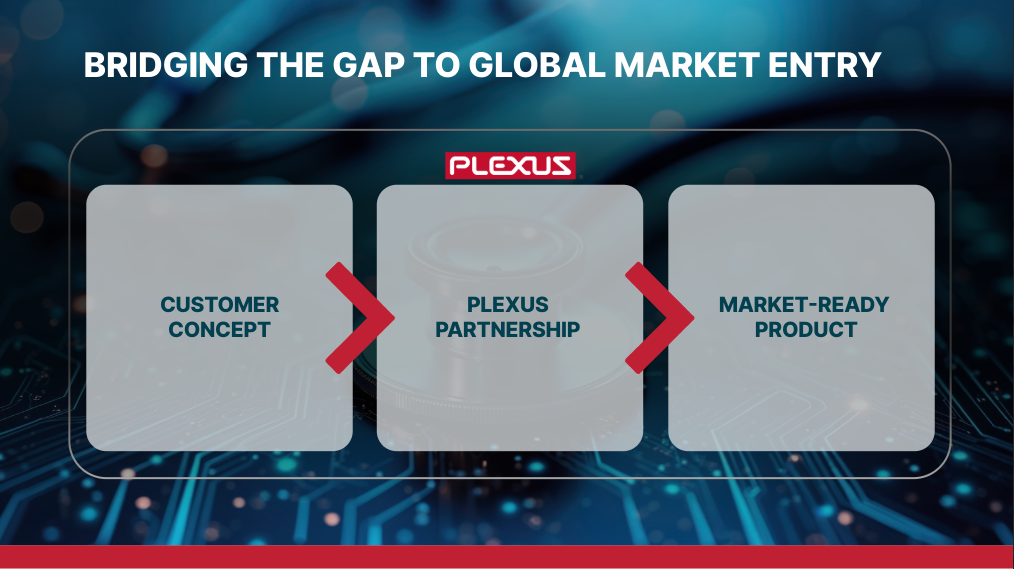
The answer requires selecting a strategic partner capable of bridging the gap between concept and market entry. At Plexus, we partner to solve real-world problems and drive successful outcomes throughout the entire product lifecycle.
Plexus ML Focus Areas: Purpose-Built for Diagnostics
Success at the edge requires moving beyond general-purpose AI. Plexus focuses on technical domains that directly impact clinical performance and device form factor including:
- Image Analysis: Leveraging machine vision and convolutional neural networks (CNNs) for real-time anatomical segmentation and diagnostic imaging.
- Low-Dimensional Data: Optimizing models for the high-precision sensor data typical of medical diagnostics.
- On-Product Models: Ensuring AI runs locally to eliminate latency and dependency on cloud connectivity and strengthen patient privacy protections.
Overcoming Data and Hardware Constraints
Edge-based ML requires a masterful systems engineering approach to balance performance with power efficiency. Traditional deep learning models are resource-intensive, often requiring gigabytes of memory that handheld or battery-powered devices simply do not have.
Plexus specializes in resource-constrained AI, with proven experience deploying ML on minimalist hardware like bare-metal 32-bit microcontrollers and FPGAs. To ensure models meet the timing, power and memory constraints typical of medical-grade edge devices, we utilize:
- Rapid proof of concept: Quickly identifying potential challenges and solutions.
- Optimization: Using techniques like pruning and quantization to shrink model size without losing accuracy.
In one instance, our team proposed a ML approach mid-project to overcome technical limitations, successfully delivering a commercially viable, regulatory compliant product.
Navigating the Regulatory Landscape for AI/ML-Enabled Devices
The regulatory path for AI diagnostic tools and the landscape for software in a medical device (SiMD) is rapidly evolving on a global scale. While the number of FDA authorized AI-enabled medical devices rose to over 1,200 in 2025, successful commercialization now benefits from a synchronized strategy that addresses FDA premarket protocols alongside EU MDR/IVDR classifications and the EU AI Act.
Plexus minimizes your risk by building diagnostic medical devices with compliance-focused development processes from day one. Our teams have decades of experience navigating FDA Class II/III and EU Class B, C, and D requirements, ensuring that your diagnostic tests meet the most stringent safety and efficacy standards. By aligning data strategies with both HIPAA and GDPR, we help innovators streamline their path to market, ensuring their breakthroughs reach patients globally without redundant redesign cycles.
Building Clinical Trust through Explainable AI
Clinicians must trust the insights a diagnostic device provides. High-stakes clinical environments may reject a “black-box” model that provides a recommendation without an interpretable rationale.
Plexus approaches ML with a focus on explainable AI to ensure transparency for both the end-user and the regulator. We can develop models that provide clear, interpretable insights, often including measures for the certainty of the model’s decision. This empowers clinicians to use AI-driven tools as a reliable extension of their own expertise, facilitating safer and more intuitive device operation. This transparency is also a critical component of global data strategy; for instance, it aligns with GDPR requirements regarding a patient’s right to an explanation for automated decisions. Building these “interpretable rationales” into the architecture from the start ensures the device is prepared for both clinical adoption and stringent data privacy frameworks.
In an unreleased lab diagnostic tool, we developed an ML system that was able to assess the uncertainty in its own predictions. This enabled it to effectively wait and collect more data, reporting a result only when it reached a specific confidence threshold.

A Partner for Every Stage of the Product Lifecycle
Market entry requires more than just a software partner; it requires a partner that understands the intersection of ML, hardware and manufacturing. Plexus provides integrated solutions that span from initial product strategy to volume medical device manufacturing, servicing and long-term planning for next generation products.
Some of our specific ML capabilities include:
- Data Strategy: In the absence of existing data, we can design custom data collection devices and execute annotation strategies, working independently or alongside your team.
- Model Architecture: We create models with the end application in mind, iteratively optimizing for accuracy and real-time performance.
- Integrated Evaluation: We continuously measure model performance against device-level product requirements during development.
- Design for Excellence (DFX): We embed supply chain and manufacturing experts early to ensure your devices are ready for volume production.
By selecting a holistic partner, you eliminate delays, optimize total cost of ownership and accelerate your path to market success. Whether your organization is looking for turnkey product design support or software team augmentation to accelerate ML development, Plexus can provide engineering services tailored to your business needs.
Contact Our Team
Ready to transform your vision into a market-ready medical device? Contact our Healthcare and Life Sciences team today to discuss how our expertise can bring your next MedTech breakthrough to life.