Michelle McCarthy, Senior Director for Industrial Business Development at Plexus, leads a team that collaborates with original equipment manufactures (OEMs) to create custom design, manufacturing and servicing solutions for data center technologies. Plexus works with a broad range of OEMs across the power and energy landscape to build novel, reliable power infrastructure that data center operators rely on.
From your recent engagement with companies, utilities and other stakeholders powering the data center market, what is your summary of the industry landscape today?
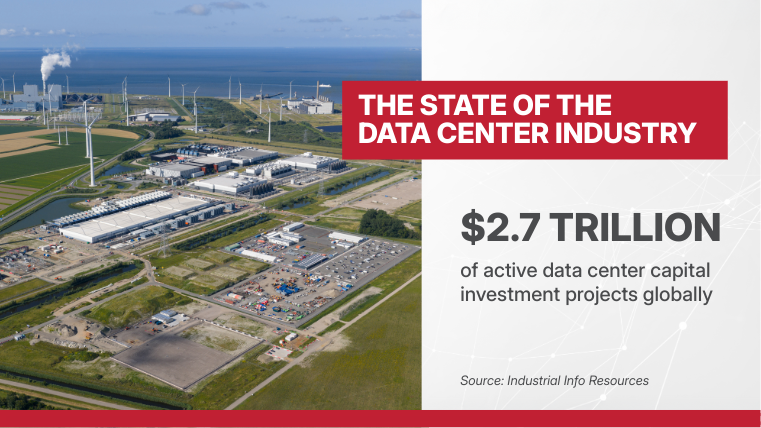
The obvious answer is that the data center industry is experiencing rapid growth and expansion, with significant forecasts extending into 2030 and beyond. Currently, there are an estimated $2.7 trillion in active data center capital investment projects globally, according to Industrial Info Resources at the recent Data Center World POWER conference. North America accounts for the largest share with $1.8 trillion. Within the US, Texas is outpacing growth as compared to other states, while Northern Virginia remains a significant hub. This is followed by Europe with $421 billion, where the majority of development is taking place in the FLAP-D markets (Frankfurt, London, Amsterdam, Paris, Dublin). In the Asia Pacific region, projects total $411 billion. There is more limited development also happening in pockets of the Middle East and Latin America.
The rapid pace of data center growth in the last two years can be attributed to several key factors: rapid AI developments and adoption, the widespread embrace of cloud computing and digital transformation, increasing digital content consumption, and the expansion of 5G networks and Internet of Things (IoT) devices.
Access to power is and will continue to be critical for data center developers. Developers and utilities must collaborate to meet rising power needs, emphasizing early planning for power and transmission to ensure continuity. Co-development, unique partnerships and overall collaboration are leading to new solutions and accelerating progress.
Clean energy infrastructure is essential, with renewable energy being deployed at an unprecedented level. Solar still dominates renewables solutions, though technologies like geothermal, nuclear and offshore wind are rapidly following to meet increasing demand.
It’s an energizing time to participate in the data center market. While there are real challenges, collaboration between grid operations, customers/hyperscalers, investors and policymakers is happening and will be paramount to deploy fast, scalable energy solutions to power economic development.
What forward-looking solutions are gaining traction among utilities and OEMs responsible for data center power generation?
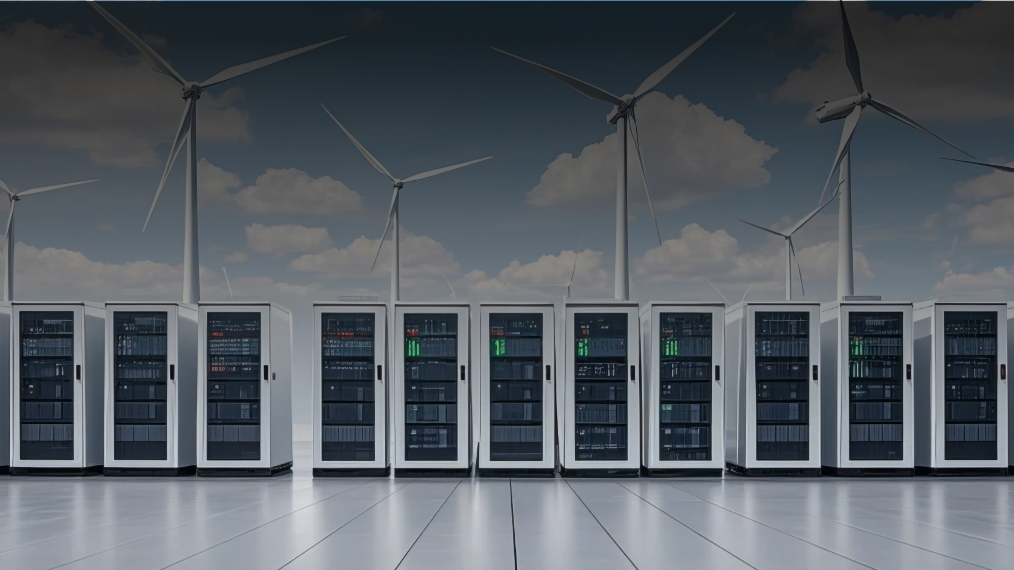
Adopting flexible and resilient energy models will be crucial for sustainable growth. Investing in Behind the Meter (BTM) power, defined as power generation or storage on the customer’s side of the meter, is one such model. In the data center, operators are utilizing natural gas turbines, fuel cells, battery storage, solar, geothermal and small modular reactors (SMRs) for power and storage. These BTM solutions offer a competitive edge, protecting data center operators from grid power limitations and ensuring uptime standards are met.
The industry recognizes that renewable energy resources will be imperative to meet data center energy needs going forward. More operators are using grid-scale batteries to help store and deploy energy to balance loads. These batteries are paired with wind and solar power solutions that can act as a ride through power supply in the face of grid interruptions. While traditional energy like natural gas continues to have a significant place, OEMs are recognizing that alternative energy sources will build resilience to continue to scale power generation for this explosive market.
What concerns or constraints are top of mind for data center power OEMs, utilities and their customers, the developers and operators?
Delays to builds are the number one concern, as lagging infrastructure and the rising costs to update or extend grids are impacting regions across the globe. This includes ongoing supply chain disruptions and constraints on key components like transformers and breakers, which can delay projects by years.
In the US, permitting delays accelerate this challenge, and legislators are struggling to balance the demand for data center investment with the need to protect existing energy infrastructure. Texas is noted as a state with an advantage, as the Texas legislature has created the ability to fast-track growth and innovation in power generation by adapting laws and regulations to meet developer’s needs. Texas serves as a model for other jurisdictions interested in capturing more of this market.
In Europe, operators and developers must navigate voluntary and mandatory regulations, such as the Climate Neutral Data Centre Pact and EU Energy Efficiency Directive reporting requirements for energy usage for data centers. The focus on waste heat recovery, for example, is forcing innovative solutions such as integrating data center facilities with district heating networks to recapture and heat local communities. However, this requires strong existing infrastructure.
A longer-term global concern exists with regard to overbuilding. As AI demand skyrockets, utilities face a dilemma: how to supply energy fast enough without overbuilding and risking stranded assets. In the US, for example, much of the electrical grid is seen to be in need of upgrades to meet demand. Traditional generation and transmission upgrades are slow and costly, which could risk US AI competitiveness.
However, flexible on-site generation offers a solution to bridge this gap. Utilities and operators alike are leveraging and dispatching clean, on-site generation to unlock capacity using existing infrastructure, enhance grid reliability and accelerate digital infrastructure deployment. These are solutions that could be applied in all markets, regardless of infrastructure concerns, to establish localized and independent power supplies at the data centers.
How can a partner like Plexus help the companies tackling these massive industry shifts meet their customer’s needs and capitalize on this moment of technological change?
Data center developers and operators are currently focused on accelerating new builds, the reliability and quality of the power in their sites, and managing energy efficiency and operating costs.
For OEMs serving these customers, having an electronic manufacturing services (EMS) partner can help overcome challenges in product development, manufacturing and servicing. This can ensure those OEMs can bring the highest quality infrastructure products to their data center customers and meet their significant expectations.
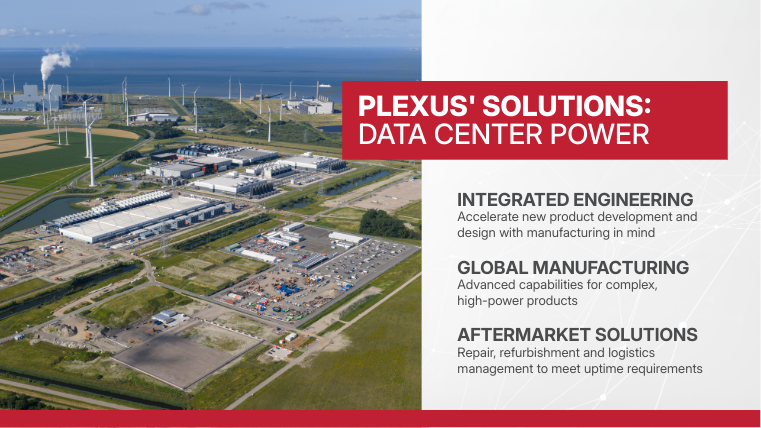
Integrated engineering services to accelerate new product development
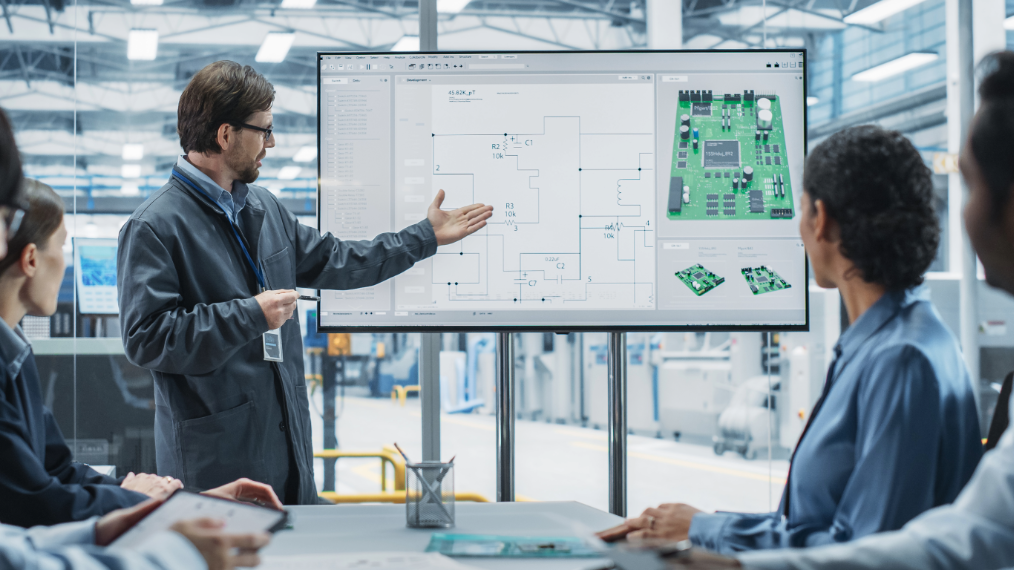
Working with Plexus, an EMS company with robust engineering services, can help accelerate time-to-market on new product development. Plexus acts as an extension of our customer’s teams to partner on designing products throughout the data center. We also apply manufacturing experience to provide services like Design for Manufacturability and Design for Test. These solutions ensure a smooth transition from product design to new product introduction and into volume manufacturing.
Plexus is also passionate about innovating responsibly as a sustainable business partner. We work with customers to develop sustainable products through services like Design for Environment and Life Cycle Assessment. These tools allow Plexus to help OEMs identify and quantify the carbon footprint of their products early in the design phase to reduce impact. The same processes can be applied to existing products to improve sustainability and decrease total cost of ownership.
Global manufacturing for complex industrial products
Plexus specializes in advanced manufacturing for high-power products. Our teams have extensive expertise manufacturing technologies in electrification, energy storage and energy management at the highest level of quality. Plexus’ product experience spans battery management systems, high-power battery chargers, power distribution units, uninterruptible power systems and beyond.
At our ISO-certified global sites, end-to-end services from printed circuit board assembly to complex high level assembly are under one roof. Our global footprint also means customers access our worldwide Supply Chain Solutions to navigate global market dynamics and address their customers’ end markets with confidence.
Aftermarket services and distribution management that improve uptime
Building strong aftermarket services with an EMS partner helps OEMs enable the reliability and uptime that data center operators demand. Plexus offers support for your service program through advanced repair and refurbishment, strategic inventory management and forward stocking, and end-to-end service logistics and process management. Working with Plexus can make the difference to deliver on your customer’s aggressive service level agreements, ensuring uptime and other requirements are met.
Contact our team to scale your data center power and energy tech
Our Industrial team is ready to partner with you on tailored solutions that lead to market success. Reach out to learn more about how we can help accelerate your data center strategy.