De-Risking Product Development Through Partnership

Key Takeaways
Original Equipment Manufacturers (OEMs) face constant pressure to launch new innovations without overspending. However, many organizations end up wasting time and resources managing a disjointed web of specialized, localized vendors. Scattering a product’s development across different design firms, suppliers and labs can create a disjointed process, leading to poor communication and costly delays.
Managing complex electronic product design demands a cohesive strategy that eliminates these operational friction points. To bypass these hurdles, forward-thinking OEMs secure a strategic partner that acts as an integrated extension of their team. This ensures brand reputation is protected through innovative, end-to-end solutions across a product’s entire life cycle.
How Does Vendor Fragmentation Increase Product Development Risk?
The traditional product development model relies heavily on sequential handoffs. A product moves from an isolated research and development (R&D) lab to a separate printed circuit board (PCB) layout specialist, then to a prototype shop and finally to a contract manufacturer. Each handoff acts as an inherent opportunity for error, where critical technical specifications can be misinterpreted and operational accountability becomes diffused.
The financial and operational consequences of this information loss can be significant:
- Costly redesigns occur when siloed design choices fail to account for factory-floor realities, forcing expensive, late-stage engineering changes.
- Delayed time-to-market happens when resolving miscommunications between disconnected teams introduces bottlenecks that disrupt launch schedules.
- Inflated total cost of ownership stems from the hidden overhead of managing multiple contracts, resolving supplier disputes and absorbing scrap costs.
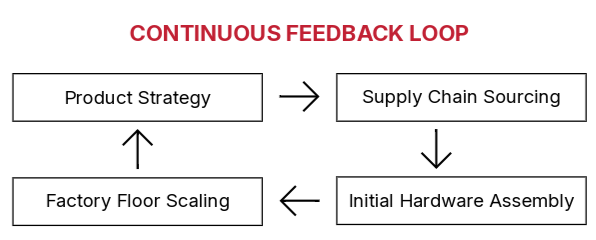
Plexus protects complex programs from these risks by replacing a fractured vendor base with a single, highly coordinated value stream. By unifying electronic design alongside supply chain management and mass production under one roof, we establish a continuous feedback loop. Instead of working in isolated silos, our cross-functional teams align from day one.
Why Should OEMs Integrate Supply Chain Strategy Early in Design?
Through proactive early supply chain engagement, components are selected not only for immediate performance but also for long-term availability and cost-efficiency. This early teamwork relies on deep Design for Excellence (DFX) analysis to identify and fix production or sourcing challenges long before the final build. This integrated approach ensures your product is designed for manufacturability, optimizing your total cost of ownership and establishing a reliable path to volume production.
How Do Early Physical Builds Accelerate Iteration Cycles?
Transitioning from a digital blueprint to physical hardware represents one of the most critical gates in electronic product design. Partnering with an integrated provider capable of seamlessly bridging design optimization and initial hardware builds dramatically accelerates your iteration cycle without requiring a dedicated or isolated prototyping shop. By utilizing early-stage New Product Introduction (NPI) capabilities within a unified manufacturing value stream, this streamlined process establishes confidence in the path forward through:
- Precise Intent Alignment: Ensuring initial physical board assemblies match digital design parameters and functional requirements flawlessly.
- Early Process Validation: Utilitizing initial production-representative builds to test, refine, and validate automated assembly, DFX analysis, and inspection routines prior to volume scaling.
- Rapid Feedback Loops: Directing real-time engineering insights from initial builds straight back to design teams, enabling swift refinements and preventing late-stage launch bottlenecks.
How Does Transition Management Smooth the Path to Contract Manufacturing?
As your innovative technology moves through New Product Introduction, the process is led by an experienced transition manager. These individuals smooth the operational bridge between early prototypes and full-scale contract manufacturing with your business priorities top of mind. They act as a single point of contact to coordinate the cross-functional team, providing expertise to guide programs through the inevitable hurdles of a launch to volume production.
How Do Product Maturity Levels (PMLs) Ensure Manufacturing Readiness?
PMLs provide an objective framework that development teams are encouraged to rely on to evaluate mass production readiness rather than depending on arbitrary timelines. While traditional project management focuses on schedules and budgets, Plexus utilizes the Product Maturity Level (PML) framework to evaluate the objective state of truth of the product. Driven by our Systems Engineers, this rigorous framework evaluates whether a design satisfies all functional, regulatory and manufacturing requirements before moving to the next phase.
The Seven-Level Progression
The PML framework guides a product through a structured, 7-level maturity progression to systematically eliminate technical and operational risks:
|
Product Maturity Level (PML) |
Core Operational Objective |
|
PML 1: Discovered |
Core technologies & functional identified and assessed against core functionality. |
|
PML 2: Feasible |
Technology feasibility demonstrated and assessed against core performance goals. |
|
PML 3: Specified |
Core technologies & functions integrated to demonstrate core performance. |
|
PML 4: Confident |
All functions integrated in near form factor to determine gaps in performance. |
|
PML 5: Integrated |
Demonstrated performance to dry run verification testing in final form factor. |
|
PML 6: Verified |
Product performance verified to meet all requirements. |
|
PML 7: Qualified |
Production process qualified and ready to ramp volume. |
What is the Role of a PML Champion?
Key to the Plexus approach to the PML framework is the role of the PML Champion, an independent evaluator who conducts objective maturity assessments at each gate.
Because these champions maintain a holistic view of the entire system, they ensure that feature decisions or design changes do not introduce unintended risks to manufacturing scalability or regulatory compliance. This independent oversight provides OEMs with the empirical data needed to make informed launch decisions, ensuring that products destined for highly regulated markets meet rigorous standards of safety and quality. This methodology works in close tandem with industry benchmarks, such as Technology Readiness Levels (TRLs), to provide total visibility into your technology’s commercial readiness.
How Does a Single-Source Partnership De-Risk Launch Schedules?
Managing the challenges of modern product development doesn’t have to mean dealing with the built-in risks of a scattered supplier network. By choosing an integrated partnership model that unifies engineering and supply chain expertise under a single quality management framework, OEMs can eliminate the handoff errors that compromise product launches.
This single-source collaboration allows internal engineering teams to remain focused on core intellectual property and long-term market growth. Meanwhile, Plexus manages the technical execution and risk mitigation across your product portfolio.
Ready to de-risk your next product launch?
Connect with our team today to learn how Plexus can optimize your supply chain and bring your innovations to market with unwavering reliability.