
Evelyn Rafferty, Senior Director of Aerospace and Defence – Europe at Plexus, leads the strategic growth of the region’s defence footprint. Evelyn collaborates with prime OEMs and tech disruptors to navigate complex regulatory landscapes, ensure regional sovereignty and rapidly scale mission-critical technologies from concept to full volume production.
Key Takeaways
The UK and European defence sectors face unprecedented operational pressures. Driven by changing security threats, major updates to the UK defence industrial strategy and broad European initiatives like Readiness 2030, procurement spending is rising at rates not seen in decades. However, increased budgets alone cannot put sovereign military capabilities into the hands of the end-user. Modern warfare demands industrial mass and rapid technological acceleration, particularly across high-density electronic assemblies, uncrewed aerial systems (UAS) and secure communications.
To explore how prime OEMs and tech disruptors can navigate this complex landscape, we spoke with Evelyn Rafferty, Senior Director Aerospace and Defence for Europe. In this Q&A, Evelyn details how leaders across the defence industry can bridge the industrial execution gap, ensure compliance with evolving procurement rules and build predictive supply chain resilience.
How do you successfully transition a complex subsystem from a TRL 6 proof-of-concept to full MRL volume production?
Transitioning a defence platform from Technology Readiness Level (TRL) 6 validation to Manufacturing Readiness Level (MRL) volume production represents the most critical hurdle in defence manufacturing. Across the defence industry, we frequently see brilliant, low-volume prototypes that perform reliably in test environments. However, production stalls when engineering teams design hardware without integrating MRL requirements.
If a subsystem design requires a specialised technician to spend 400 hours hand-tuning a single sensor array, it demonstrates technical functionality, but it will stall during low-rate initial production (LRIP). To escape this artisanal, high-cost build model, MRL maturation must advance in parallel with the technology roadmap.
Bridging this gap requires embedding DFX methodologies, specifically design for manufacturability (DFM) and design for testability (DFT), at early new product introduction stages. Before freezing a design, engineering teams should evaluate automated optical inspection (AOI) access, physical error-proofing (poka-yoke) and perform early thermal and signal integrity simulations for high-density mechatronics. Building serial-representative pre-production units ensures technology is hardened for repeatable, full-scale industrial manufacturing.
How does the Procurement Act 2023 shift standard compliance guidelines for UK defence authority contracts?
The era of globalised, single-source procurement is over. Shifting regulatory frameworks, such as the UK Procurement Act 2023, national content mandates and European Defence Technological and Industrial Base (EDTIB) directives, mean that regional compliance across the defence supply chain and data sovereignty are now strict conditions of entry. If a formal government audit uncovers a non-compliant component or a part sourced from a ‘covered foreign entity,’ an entire defence contract can be frozen.
To achieve true operational sovereignty,OEMs and suppliers are encouraged to remove non-compliant foreign components early in the design cycle. Organisations achieve this by partnering with localised, International Traffic in Arms Regulations (ITAR)-independent manufacturing facilities within allied borders.
For example, at Plexus, we utilise design and manufacturing centres in Livingston (Scotland) and Oradea (Romania). This distributed European footprint allows global companies to meet stringent local content targets, navigate complex export controls and ensure strict data protection under identical, zero-defect quality systems.
How can defence prime contractors shift from basic reactive parts sourcing to predict supply chain resilience?
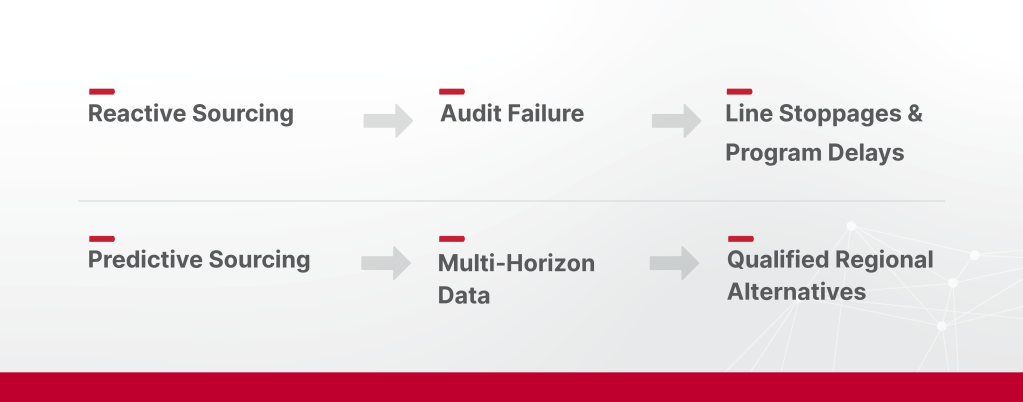
Modern defence procurement faces volatile lead times for critical microelectronics, severe single-source dependencies and rapid component obsolescence. Traditional supply chain management risk mitigation remains reactive: organisations wait for a last-time-buy notice or line-side shortage before sourcing alternatives.
To protect programs with multi-decade operational lifespans, defence primes should transition to predictive resilience. This requires utilising advanced predictive analytics toolsets capable of auditing multi-tier supplier networks.
Within our supply chain operations, we utilise proprietary analytics platforms such as ALARM™ (Assembly Level Analytics of Risk Management) and DRIVE (Differentiated Risk Insight and Valued Execution). These tools evaluate component risk profiles to actively mitigate global supply chain risks and simulate market disruptions across multi-year planning horizons. By identifying obsolescence risks and single-source vulnerabilities during the design phase, engineering teams can qualify localised, alternative parts long before supply disruptions hit the factory floor.
How can the industry rapidly scale to restore industrial mass without massive capital expenditure?
Surging demand for self-propelled artillery, uncrewed systems and automated hardware requires the defence sector to restore physical industrial capacity rapidly. However, building internal capacity through greenfield plants requires immense fixed capital expenditure, long regulatory approval lead times and years of corporate overhead. Compounding this challenge is a severe regional engineering talent shortage across software, microelectronics and systems integration.
Partnering with a qualified Electronics Manufacturing Services (EMS) provider eliminates these capital bottlenecks. By partnering with an established EMS provider, defence OEMs can tap into certified, pre-existing manufacturing capacity. This allows companies to scale volume while keeping internal engineering teams focused on evolving their core intellectual property.
|
Operational Factor |
Internal Greenfield Expansion |
Strategic EMS Partnership |
|
Capital & Overhead |
High fixed CAPEX and high ongoing operational overhead |
Lean fixed-asset base with scalable, variable cost structure |
|
Time-to-Market |
Multi-year facility builds and lengthy regulatory approvals |
Immediate access to defence-certified, accredited production lines |
|
Engineering Talent |
Subject to regional engineering acquisition bottlenecks |
On-demand access to specialised NPI and assembly engineering |
|
Scaling Flexibility |
Rigid local capacity constrained by single-site infrastructure |
Scalable regional footprint across UK and European facilities |
How should defence manufacturing adapt to support high-growth, software-driven technologies?
Technologies deployed in high-growth segments, such as UAS, counter-UAS and tactical communications, are evolving in cycles of weeks or months rather than years. Manufacturing environments must therefore be flexible enough to support continuous software baselines and hardware modifications without halting production lines.
Additionally, these high-density electronic modules operate in congested and contested radio spectrums, raising significant technical challenges in thermal management and signal integrity. EMS partners provide specialised engineering depth to address these complex constraints.
Hardware engineering leaders can scale disruptive platforms cost-effectively while guaranteeing mission-critical reliability. They do this by offloading higher-level assembly integration, complex mechatronics and automated functional testing to specialised manufacturing centers.
Securing your operational blueprint
As the defence sector shifts toward software-defined hardware and rapid platform iterations, leaders are evaluating their operational frameworks. The path forward requires a clear distinction: focus on core IP and proprietary architecture and partner for everything else.
At Plexus, we bridge the gap between ambitious defence strategies and real-world deployment. By combining deep compliance expertise with advanced manufacturing capabilities, we help Prime OEMs and tech disruptors scale production and strengthen supply chain resilience.
Contact Our Team
Connect with the Plexus Aerospace & Defence Team to learn how we can help you scale at the speed of relevance.